Demonstration of sound impact with car engine

The Impact of Sound

How much does sound impact us? Even in a subtle way, sound influences our thoughts and emotions—and it often does without us being aware.

Here’s a quick experiment to play with what I mean. Take a listen to this 15-second video with the sound OFF, then play it again with the sound on.

How did hearing the sound change your experience?

Last summer, I took my fabulous 2007 Honda Civic in for a pre-emptive check. I can hardly believe how low maintenance it’s been for 18 years.

But I’d been hearing a slight sound difference. I’m very tuned in to my car. So, while I asked my mechanic to look over what would make it last another year, I also requested that he check the exhaust system. The answer?

Besides new tires this winter, you’re good to go. Oh, and you do have a tiny hole the size of a ballpoint pen tip in your exhaust pipe. But there’s plenty of time before that’ll need replacing

I appreciated his integrity and still chose to replace it right away. No one else could hear the sound yet, but my vehicle and I are in synch. Why wait?

Similarly, when we’re in synch with ourselves, we’re aware of subtle changes in thoughts and emotions that can signal the very beginnings of a larger issue. Even a slight shift can bring us down, and we want to stay buoyant. 

Choosing to repair a tiny hole in our happiness now saves a much bigger problem down the road.

So, here’s another experiment. This week, take a moment periodically to tune into subtle sounds. Focus on the ones that have an uplifting impact, open your heart, or make you laugh.

And if you notice any tiny disturbance, handle it now. 

That is living as music.

Snow Raven, singer, in elaborate blue and gold costume singing at the microphone

I Am a Wind Instrument

My first lesson with a new singing teacher rocked my world. You are a wind instrument, she said, and I couldn’t imagine how I’d missed this blatant truth. Without air, we cannot make sound. We give shape and form to the wind itself.

Now, meet a remarkable woman who explores this connection in an astonishing way. Snow Raven is an indigenous singer from the Arctic Circle who learned to mimic nature sounds. Hear how she embodies the principle of being an instrument:

Snow Raven amplifies our kinship with the natural world while expanding our view of the human voice. [Her 8-minute TED Talk “How I Imitate Nature’s Voices,” includes several examples. If you’re a loon lover, just wait!]

What is it about this instrument we carry that’s so intriguing? Most of us barely recognize the gift of making sound. We’re often locked into narrow communication confines needed to navigate daily life.

Not that we all want to sound like the wind or a coqui frog. But, honestly, how much do we limit our expression? Would we like to be more vocally creative or daring? To give voice to some essential part of ourselves that wants to be shared?

Here’s an experiment. Try saying to yourself, I am a wind instrument, and see how it feels. Because as much as we can’t make sound without air, air can’t make sound without us.

Discover what your voice can do, if only in the privacy of your own car or shower stall. Risk singing out when no one’s around or speaking up when you know it’s your turn. 

Let’s play with sound—natural, tribal, truth-telling, or non-sensical—and see what we learn about ourselves, our wind instrument, and our connection to all life.

That is living as music.

Subscribe here for Living As Music

Blue background image of sound frequency in the form of a vibrating circle

Healing Sound Frequencies?

Is it possible to heal our body, feelings, or mind using sound frequencies? Sound therapists and scientists appear to be discovering the same truth. That frequencies of sound can at least invite, if not bring about, relaxation, release from anxiety, deeper sleep, and healing.

I’ve been experimenting with a low frequency sound (175 Hertz) to reduce pain. The following short sample combines 175Hz with other vibrations to encourage a theta brain wave state. Theta is the wave our brains produce when drowsy, lightly sleeping or in deep relaxation.

I aim for the most pure and refined sound in what I allow into my consciousness and what I give out through my voice. Granted that’s a tall order! But one step I can take is to test out sounds to see what beneficial impact they may have on me as an individual. 

The older I get, the more careful I am at taking anything from an outside source at face value. For example, the advent of AI has required even more alertness and attunement to my inner guidance. 

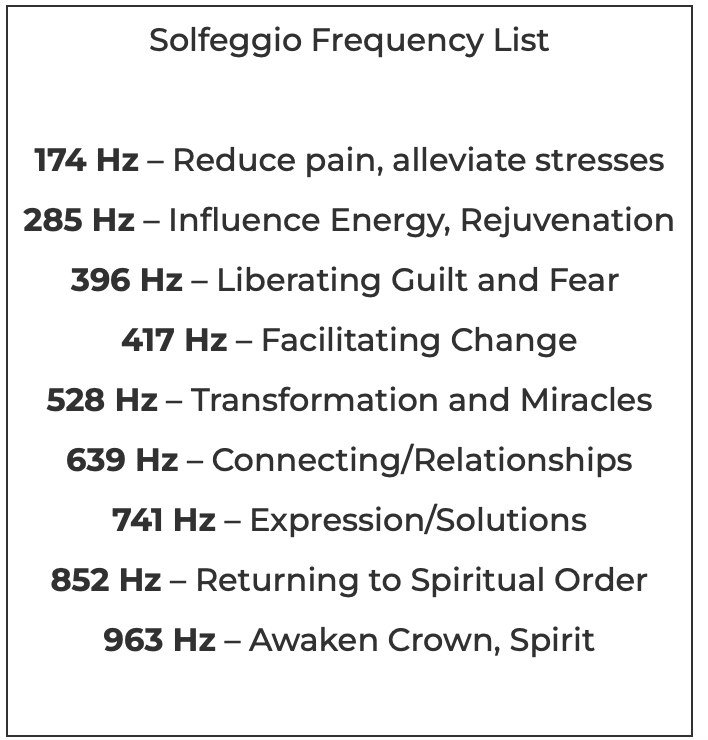
With that bit of a disclaimer, if you’d like to test out particular sound frequencies, the following is the best video I can find to sample nine currently recognized beneficial tones. (10 min). 

What impact do these sounds have as you listen? 
Which sounds are you drawn to for peace, balance or healing?

If it’s helpful, this guide below lists possible benefits from listening to the nine frequency vibrations. Perhaps your experience matches, or maybe you feel something different.

In chaotic times, every tool we can find to strengthen the integrity of our bodies, minds, and emotions is welcomed. We want to be strong, secure, and sound within our own being. 

Let’s listen inside ourselves first and foremost for our highest guidance and truth. With that intention, we’ll be led to the gifts of sound that uplift, purify, and heal.

That is living as music. 

******************************************
If you received this from a friend, check out other topics here, or subscribe below for monthly posts.💛

Subscribe here for Living As Music

The Bells of Notre Dame

The bells of Notre Dame do more than ring out. They are always alive, responding to life around them. “It’s a physical fact that these bells are actually vibrating all the time; it’s like a spirit that’s living inside of Notre Dame,” sound artist Bill Fontana told The Art Newspaper.

How does he know? After the 2019 fire, Fontana recorded harmonic pitches that the metal creates when not in motion. Check out this clip from his sonic installation, Silent Echoes: Notre-Dame (2 min):

Fontana recorded and mixed the “still sound” of the 10 bells and adjusted the levels to human hearing. He described the sound of the bells as acting like acoustic mirrors

“They’re reacting to life around Notre Dame. The slow and prominent hum of the massive bells rings in the foreground, and ambient sounds of the surrounding area flitter in the background — the noise of construction in the cathedral, a musician’s melody from the street below, birds singing in the bell tower.”

That’s a startling discovery. Are we also acoustic mirrors that react to ambient sounds, barely aware of the vibrational impact?  

An example. If my husband turns on the nightly news, he keeps the volume low. He’s very considerate of my sensitivity to the sound of reporters. Their cadence (let alone the content) makes my skin crawl, and I don’t want to be the effect or the reflection of that frequency.

Gratefully, we humans have more choice than bells. The words we speak and emotional tenor we carry can uplift our environment, if we’re mindful of our impact.

At the deepest level, our unique vibration identifies us. When we’re conscious of our signature sound, we’re truer to ourselves and to the sounds we express.

That is living as music.

Subscribe here for Living As Music